dossier.technology · private beta

The file of record,
executed in‑house.

dossier reads an institution's document archive, keeps track of what is owed and what has arrived, and drafts whatever the work needs next: an appraisal file, a grant dossier, a diligence pack. It runs end to end on hardware you own. No public AI services. No API keys. No telemetry.

This page loads no fonts, no analytics and no third-party scripts. It seemed like the least we could do.

0bytes leave your network under the default posture
800+documents indexed per engagement, and growing
hoursto a full first draft set, where weeks were budgeted
100%of model-proposed changes land as reviewable patches

The problem

Three constraints shape every serious document engagement.

Any one of them rules out the obvious tool. Together they have kept this work manual.

01

The material cannot leave.

Appraisal files, grant dossiers, diligence packs and counsel correspondence sit under confidentiality obligations that a consumer AI subscription cannot satisfy. For a development bank or a ministry, "where does the prompt go?" is a procurement conversation before it is an engineering one.

02

Assembly is priced in expert‑days.

Most of the cost is not judgement. It is reading eight hundred files, reconciling a register against the evidence actually received, chasing what is missing, and assembling drafts that a senior reviewer will then correct. Weeks of it, per file.

03

A claim without provenance is worthless.

In a file of record, an unattributable sentence is a liability. Every figure needs the document, the page and the date behind it. A system that can quietly invent one is worse than no system at all.

How it works

One loop, run continuously, with a human on the gate.

You steer it in plain language. It does the assembly and stops where judgement begins.

  1. 1 Ingest

    PDF, DOCX, XLSX, HTML, RTF, email, scans, call recordings. OCR for the image-only pages, local transcription for the audio. Every binary gets a greppable text mirror with a checksum and an honest note on what was lost.

  2. 2 Index

    Hybrid keyword and semantic retrieval, fused by rank. Citations resolve to the original document, page and sheet, never to a scraped copy. Real corpora are multilingual, so retrieval is too.

  3. 3 Reconcile

    The register is the source of truth and the roll-up is computed, never typed. Rows whose status disagrees with the evidence on file are surfaced the day the evidence arrives, not at the next review.

  4. 4 Detect

    What is owed, by whom, and since when. New arrivals are matched against outstanding obligations, and everything they make stale is flagged as a sentence you can read, not a diff you must decode.

  5. 5 Draft

    Deliverables are written section by section from the corpus, versioned and dated, in whatever shape the engagement actually calls for, rather than from a taxonomy fixed in code. Word and PDF come out of the data, natively.

  6. 6 Hold for approval

    Every change the model proposes arrives as a typed patch carrying its before, its after, its citations and its reasoning. You accept, edit or reject. Nothing is sent anywhere, ever, without you.

dossier · workspace
The dossier workspace: a chat thread on the left, cited answers and a live register on the right.
Ask in plain language, get an answer with the page it came from, and watch the register move as evidence lands.

Capabilities

What you get once the archive is in.

Answers with a page number

Every claim quotes the document it came from, with the locator a person can check: page, sheet, cell, speaker, timecode. Reliability caveats travel with the citation.

Registers that compute themselves

Status roll-ups are derived from the evidence rows beneath them. A number nobody typed is a number nobody can mistype.

Deliverables, versioned and dated

Every draft is a version with a lineage. Re-draft when the corpus moves, and see exactly what the new material changed.

A git repository underneath

Each workspace is a real repo and each mutation is a commit. Audit, diff and undo come free with that. They were never features anyone had to build.

Anything in, cleanly

Office formats, scans, email archives, web pages, meeting recordings. OCR and speech-to-text run locally, so confidential audio never leaves the room it was recorded in.

Multilingual on purpose

The corpus is asked in every language it contains, so a Cyrillic annex does not vanish because the question was posed in English.

Roles that mean something

Viewer, contributor, approver and owner, enforced at the route and set per project, with passkeys or your own identity provider. Proposing is cheap. Accepting is not.

Retire without deleting

Archive a finished engagement and it becomes read-only, still searchable, still renderable, reversible at any time. Destruction requires archiving first, and typing the name back.

Deployment

One codebase, in whichever shape suits you.

The models run where you put them. A single-tenant install is the same application with one organisation in it, not a stripped-down fork.

The floor

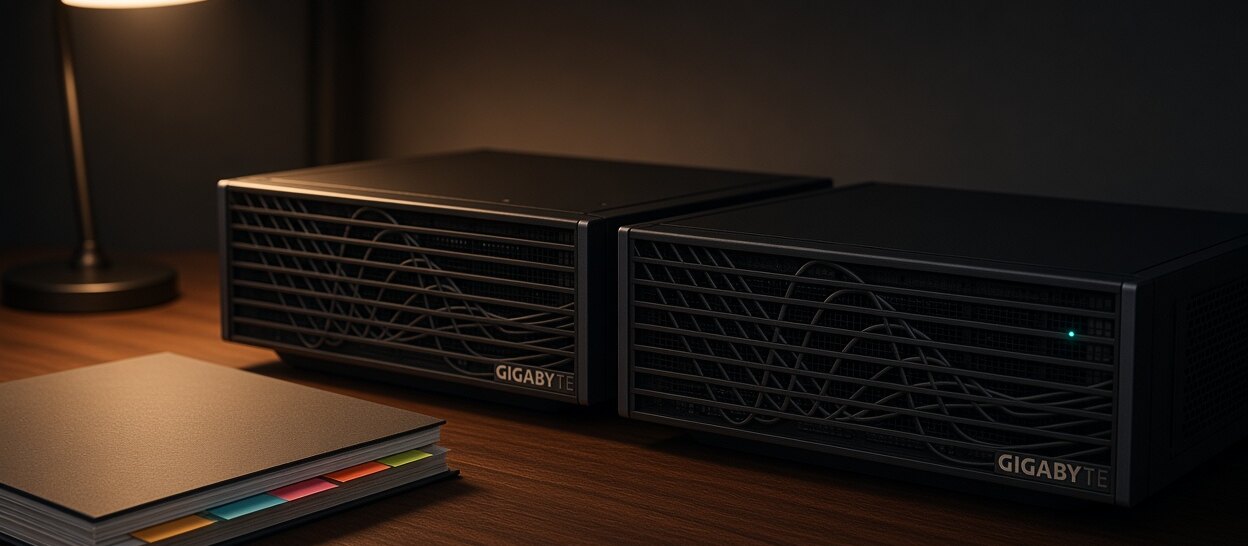
Two boxes on a desk

A pair of desk-class AI machines, around ten thousand euro for the two, will index a full engagement archive and draft its deliverable set in an afternoon. No rack, no data centre, no account with anyone. That is the entry point, not the ceiling.

  • No API keys, no accounts, no telemetry
  • Runs offline; the network cable is optional
  • One consultant, one engagement at a time

The deployment

The servers you already run

Put it in your own data centre and the same application serves whole teams: more capable local models, several engagements at once, concurrent users, your identity provider, your backup regime. It stays just as private, and nothing leaves your perimeter.

  • Linux, Windows or macOS; a single static binary
  • SQLite by default, PostgreSQL where you need it
  • Per-project isolation on disk, not by a WHERE clause
Two compact AI compute units on a desk beside a printed dossier.
Two GB10 machines, 128 GB each. That is the floor. The same build runs on rack hardware in your own data centre.

Why it can be trusted with the file

Where the guarantees are actually enforced.

It cannot make a change it cannot show you.

Citations are resolved from the indexed corpus, never authored by the model. A proposal pointing at material this project does not hold is refused outright. A sentence planted inside an uploaded document therefore cannot move a register row on its own say-so.

Reaching the internet is a deployment posture.

Web access is off by default, warns loudly at every start when relaxed, and can be refused per engagement regardless of the install-wide setting. A search query is composed from your corpus; treating that as a mere toggle would be dishonest.

A capability that is off will say so.

When a tool is unavailable, the model is told, and told why. A model that is simply not told it lacks web access will fill the gap from memory, with all the confidence of a cited fact. Silence is the dangerous default.

The vendor cannot read your files.

The operator's administrative reach covers organisations, roles and configuration. It does not reach the documents, the chat or the registers. Reading those requires a membership your own administrator grants, sees, and can revoke.

Who it is for

Anywhere the deliverable is a file that must hold up.

  • International financial institutions: technical appraisal, monitoring, disbursement conditions.
  • Grant and programme administration: application dossiers, compliance files, reporting cycles.
  • Advisory and engineering consultancies: engagements measured in deliverables and expert-days.
  • Public administrations: procurement files, project documentation, institutional memory.
  • Legal and diligence teams: document review where the material cannot travel.

Early access

Bring us your hardest archive.

dossier is being proven on live engagements before it is sold to anyone. If your work looks like this, tell us about the file you would point it at. We answer personally.

Or write directly to file@dossier.technology. We keep the address and nothing else.